Imagine a school that bans notebooks because students might rely on them instead of remembering what they learn.
The concern is understandable. If you write something down, you may make less effort to memorize it. But banning notebooks would also take away a powerful way to organize ideas, compare evidence, and work through difficult problems.
Protecting one skill would come at the expense of developing others.
In my book, The Cognitive Revolution: How AI Is Reorganizing Intelligence, Expertise, and Institutions, I put the problem this way:
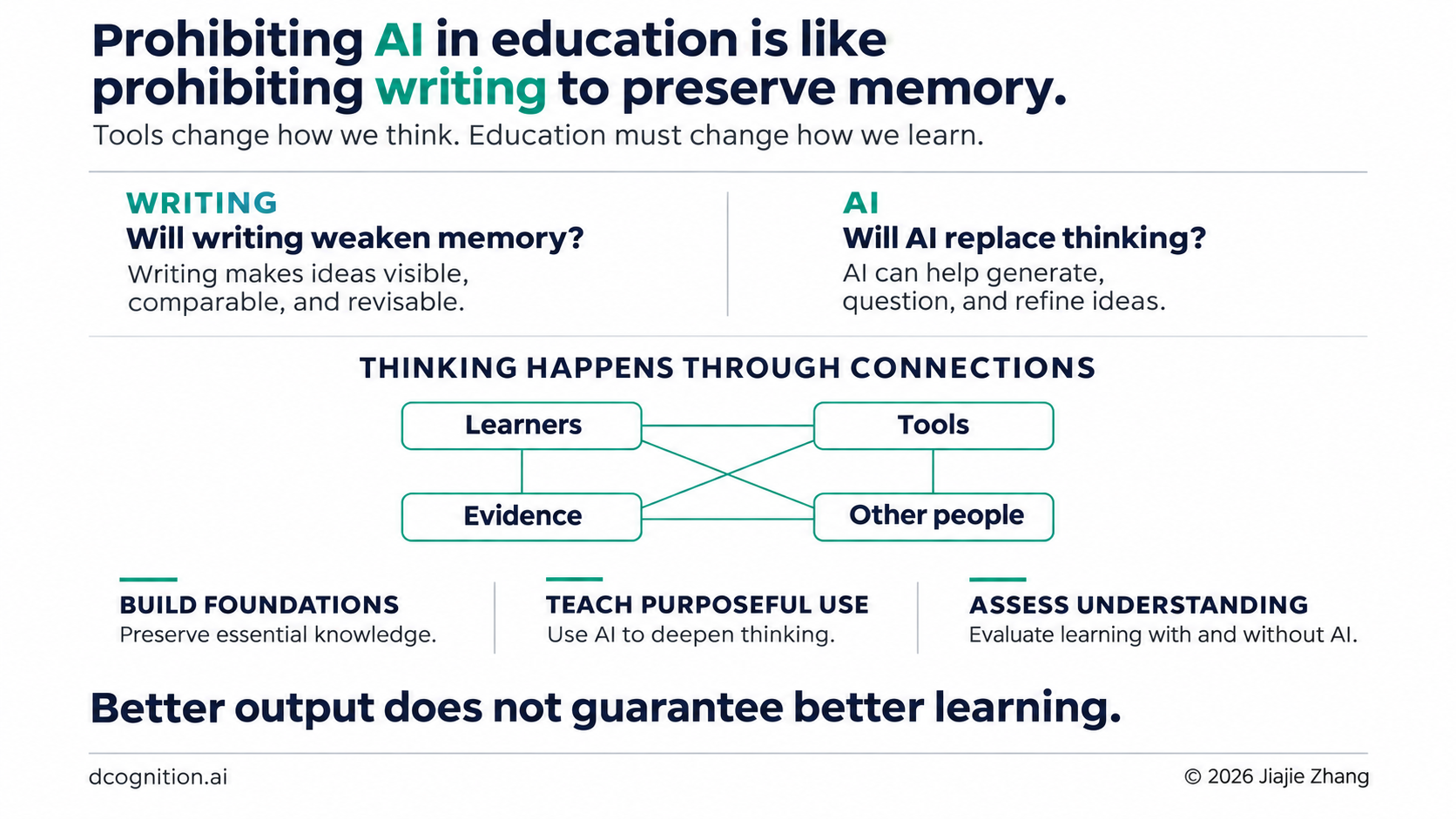
“Prohibiting AI in education is like prohibiting writing to preserve memory” (Zhang, 2026, p. 75).
The question reaches far beyond homework. It matters to parents raising children, teachers designing lessons, universities awarding degrees, employers training professionals, and governments deciding what education should prepare people to do.
What should people learn to do for themselves? What should they learn to do well with powerful tools? And how do we make sure those tools help people become more capable?
A ban cannot answer those questions. Education has to.
1 The warning about writing survived because someone wrote it down
The concern that a new technology might weaken the mind is ancient.
In Plato’s Phaedrus, Socrates tells a story in which the god Theuth presents writing to King Thamus. Theuth believes his invention will improve memory and wisdom. The king sees a problem:
“For this invention will produce forgetfulness in the minds of those who learn to use it, because they will not practice their memory” (Plato, 1914, 275a).
That is the wording in Harold North Fowler’s translation, at passage 275a. The familiar phrase “writing destroys memory” is a paraphrase. The warning comes from Thamus in a story Socrates tells within Plato’s written dialogue.
The story also raises a concern that sounds remarkably current: people might gain access to many words and mistake that access for understanding (Plato, 1914, 275a–b).
That concern deserves respect. Reading an explanation does not guarantee that you understand it. Receiving an answer from AI does not guarantee that you can explain it.
But a warning about misuse does not settle how a technology should be used. Plato’s discussion itself allows writing a role as a reminder (Plato, 1914, 276d). It is more thoughtful than a simple demand to ban it.
The lesson for us is to take the risk seriously and design education around it.
2 We have never thought with our brains alone
Try planning a complicated project entirely in your head. Now put the tasks on a page, arrange their order, and draw the connections.
The page helps you remember. It also helps you notice something you had not thought of: a missing step, a conflict, a dependency.
The same thing happens when you put two arguments side by side. A contradiction that escaped you while listening may become obvious when both are visible. A graph can reveal a pattern that is difficult to see in a list of numbers.
These tools change what thinking makes possible.
Cognitive scientists call this distributed cognition. The term means that thinking happens through the interaction of people, tools, information, and their surroundings. My research with Donald Norman explored how information inside the mind and representations outside it work together in problem solving (Zhang & Norman, 1994; Zhang, 1997). Edwin Hutchins (1995) examined a similar process in ship navigation, where people, instruments, and shared procedures form a larger thinking system.
The idea is straightforward: much of what we accomplish intellectually depends on how we work with things and people beyond ourselves.
AI adds a more active participant to that arrangement. It can suggest an alternative explanation, challenge an assumption, or help develop a question. Imagine a student who begins with a vague idea, explores competing explanations with AI, checks the evidence, and emerges with a sharper question. The thinking develops through the exchange.
The exchange can help the student organize work that would have been difficult to manage alone, and discover possibilities the student had not yet imagined.
Of course, the student could also copy an answer and learn almost nothing. That brings us to the distinction every education policy needs to make.
3 A better assignment does not necessarily mean a better educated student
An excellent essay can hide a student who understands very little of it. A correct answer can hide a student who cannot solve a similar problem tomorrow.
This problem becomes more serious when a tool can produce the very work an assignment was designed to teach.
Educational researchers have long distinguished between what a person can accomplish with technology and what that person learns from using it (Salomon et al., 1991). Those are related questions, but they require different evidence.
Two studies show why the distinction matters.
In a study by Bastani et al. (2025), nearly 1,000 students at a high school in Turkey practiced mathematics under different conditions. Students using a general AI interface did better during practice. When they later worked without AI, however, they performed worse than students who had practiced without it. A specially designed AI tutor largely avoided that harm, although the researchers did not find clear evidence that it improved students’ independent performance beyond the comparison group.
The assignment had become easier. For some students, the learning had become weaker.
A different study by Kestin et al. (2025) involved 194 Harvard students and two introductory physics lessons. Students learned more on immediate tests after using a carefully designed AI tutor than after an active classroom lesson. The tutor had been built around teaching principles and instructor-prepared materials.
Both studies examined particular settings and short-term outcomes (Bastani et al., 2025; Kestin et al., 2025). They do not establish what every child, college student, or professional will learn over months or years. They do establish why we need to examine how AI is used.
A system that delivers finished answers and a system that asks students to explain their reasoning create very different learning experiences.
For a parent, the useful question is what the child can now explain or do. For a teacher, it is what capability the assignment develops. For a public agency funding educational technology, it is whether the investment improves learning.
The homework can improve while the student falls behind. We must measure the student.
4 Students still need knowledge in their own heads
Access to AI does not make understanding optional.
You need knowledge to recognize a misleading answer. You need enough background to notice when an explanation leaves out something essential. You need some idea of how evidence works before you can judge whether a claim deserves belief.
Telling students to “check the AI” is therefore not a complete teaching strategy. Checking requires skills that must themselves be taught.
Students need practice finding original sources, comparing explanations, testing a calculation, and recognizing when they need help. They also need practice remembering. Research on learning has shown that recalling material from memory can improve later retention more than repeatedly studying it (Roediger & Karpicke, 2006).
This gives us a clear reason to retain periods of independent work. A teacher might ask students to explain a concept without assistance, use AI to explore objections, and then apply the concept to a new problem on their own.
The purpose of each stage is explicit. Students develop understanding, examine it, and demonstrate that they can use it.
Experience matters, too. A skilled professional may safely delegate work because years of practice have taught that person what to look for. A beginner may still need to do that work to develop the same understanding.
A beginner needs practice in things an expert may be ready to delegate.
That is why a sensible approach cannot treat an elementary school student, a doctoral student, and an experienced professional as if they need identical rules.
Nor should we expect a person to reproduce everything an AI system can do. The educational goal is to build enough understanding to ask useful questions, examine the answers, recognize limits, and make responsible decisions.
5 What this could look like in real education
The following examples illustrate an approach. Their effectiveness should be evaluated in the settings where they are used.
In K–12 education, AI should support the development of basic abilities. A student learning fractions might attempt a problem, receive a hint from a teacher-approved tutor, explain the next step, and later solve a different problem without assistance. The teacher can see whether understanding is developing. Children also need time to read closely, write their own sentences, and work through uncertainty. The amount and kind of assistance should fit their age and the lesson’s purpose.
In higher education, AI can help make the intellectual work more demanding. Instead of asking only for an essay, a professor could ask students to develop a position, use AI to find the strongest objection, consult original sources, and explain how their thinking changed. A brief discussion or a new application can test whether they understand the result. Students would be assessed on the quality of their reasoning and decisions, along with the final work.
In professional education, AI should be part of learning how to work responsibly. A training exercise might ask participants to use AI to prepare an analysis, then identify missing information, test its assumptions, and explain when a more experienced colleague is needed. An experienced professional should also practice recognizing when the system is wrong, when its answer does not fit the situation, and when work should pause.
Across these settings, assistance can be introduced, limited, or withdrawn according to what the learner needs to develop. An exercise without AI can be valuable. So can an exercise that makes skilled use of AI essential to the task.
The important connection is between the activity and the learning objective.
Teachers remain central to that work. Someone must decide what students need to learn, recognize misunderstandings, design appropriate challenges, and determine whether progress is real. Giving every student a chatbot does not accomplish those things.
Teachers also need time, training, and workable assessment methods. A policy that announces innovation while leaving faculty to redesign everything on their own has not finished the job.
6 Decision makers need to ask better questions
For school boards, university leaders, employers, and government agencies, the writing analogy points toward a more useful policy debate.
Start with the capabilities people need. Then decide where AI can help develop them, where independent practice is essential, and what evidence will show whether the approach is working.
A district can count how many students received AI accounts. That number tells us little about how many students learned more. A university can report how many faculty attended AI training. Attendance alone does not establish better teaching.
We need evidence of understanding, retention, and the ability to use learning in a new situation. We should also examine whether students become better at working with AI, challenging its claims, and recognizing when outside help is necessary.
These questions belong in decisions about funding, purchasing, curriculum, and assessment.
Access matters. If an assignment requires AI, students should have access to suitable resources. A grade should not depend on whether a family can afford a better subscription.
Privacy and appropriate safeguards matter, especially for children and sensitive information. Academic honesty matters, too. Students should disclose assistance when required, follow the conditions of an assignment, and support their claims with evidence.
Clear rules can protect these purposes while leaving room for different subjects, ages, and stages of learning. A schoolwide ban and unrestricted use are both blunt answers to a problem that requires educational judgment.
A rule tells people what is allowed. A curriculum determines what they learn.
7 Preserve the ability to think while expanding what thinking can do
The analogy with writing does not prove that every use of AI will improve education. Its value is that it helps us recognize a recurring mistake: judging a new way of thinking only by the familiar activity it might replace.
Writing can reduce the need to remember a particular detail while helping someone construct a more complex argument. AI can take over an important learning activity, or it can help a learner explore a difficult question more deeply. We have to examine the consequences for the person doing the learning.
That requires more work than declaring the technology either a miracle or a menace.
It requires educational institutions willing to redesign assignments. It requires teachers with the support to develop new approaches. It requires leaders who ask for evidence and revise their policies when the evidence changes.
Above all, it requires keeping the learner’s development at the center.
Prohibiting AI in education is like prohibiting writing to preserve memory because it can protect a familiar practice while preventing us from learning how to think through a new one.
Our responsibility is to prepare people who can understand, use, and question powerful systems, including knowing when to refuse their answers.
Preserve the capacity to think. Expand the ways we can do it.
References
Bastani, H., Bastani, O., Sungu, A., Ge, H., Kabakcı, Ö., & Mariman, R. (2025). Generative AI without guardrails can harm learning: Evidence from high school mathematics. Proceedings of the National Academy of Sciences, 122(26), e2422633122. https://doi.org/10.1073/pnas.2422633122
Hutchins, E. (1995). Cognition in the wild. MIT Press. https://doi.org/10.7551/mitpress/1881.001.0001
Kestin, G., Miller, K., Klales, A., Milbourne, T., & Ponti, G. (2025). AI tutoring outperforms in-class active learning: An RCT introducing a novel research-based design in an authentic educational setting. Scientific Reports, 15, Article 17458. https://doi.org/10.1038/s41598-025-97652-6
Plato. (1914). Phaedrus (H. N. Fowler, Trans.). In Plato in twelve volumes (Vol. 1). Harvard University Press; William Heinemann. Perseus Digital Library text.
Roediger, H. L., III, & Karpicke, J. D. (2006). Test-enhanced learning: Taking memory tests improves long-term retention. Psychological Science, 17(3), 249–255. https://doi.org/10.1111/j.1467-9280.2006.01693.x
Salomon, G., Perkins, D. N., & Globerson, T. (1991). Partners in cognition: Extending human intelligence with intelligent technologies. Educational Researcher, 20(3), 2–9. https://doi.org/10.3102/0013189X020003002
Zhang, J. (1997). The nature of external representations in problem solving. Cognitive Science, 21(2), 179–217. https://doi.org/10.1207/s15516709cog2102_3
Zhang, J. (2026). The cognitive revolution: How AI is reorganizing intelligence, expertise, and institutions. Open Intelligence Press. https://www.amazon.com/dp/B0GWMHQSNG
Zhang, J., & Norman, D. A. (1994). Representations in distributed cognitive tasks. Cognitive Science, 18(1), 87–122. https://doi.org/10.1207/s15516709cog1801_3
Continue Reading and Watching
Book: The Cognitive Revolution: How AI Is Reorganizing Intelligence, Expertise, and Institutions
Video and the story behind its creation: Watch my 12-minute video and read how I created it with AI
Website: dcognition.ai
Subscribe for more essays on AI, distributed intelligence, education, and institutional change. Share this essay with someone helping shape the future of education.
How I Use AI
The ideas, arguments, and conceptual framework originate in my research and my book. For this essay, I used AI as a cognitive partner to expand the argument, research sources, develop drafts, and refine the writing. I retain responsibility for the intellectual direction, conclusions, and final text. This collaboration reflects a central theme of my work: thinking increasingly takes place through distributed systems.
© 2026 Jiajie Zhang. All rights reserved.
Brief quotations with attribution and a link to the original publication are welcome. No part of this article may be reproduced, republished, or distributed in whole or in substantial part without prior written permission from the author.
No approved comments yet. You can begin the discussion.