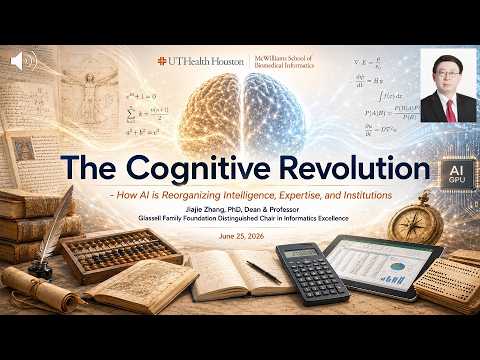
The clearest public introduction to the central argument of The Cognitive Revolution: AI is not simply automating tasks. It is reorganizing how intelligence is produced, distributed, and governed.
Selected talks and audio adaptations from the world of The Cognitive Revolution.
Begin with the flagship keynote, then explore focused audio adaptations of the book, essays, and published work.
Featured Talk
The clearest public introduction to the central argument of The Cognitive Revolution: AI is not simply automating tasks. It is reorganizing how intelligence is produced, distributed, and governed.
Listen
These episodes adapt Jiajie Zhang’s published work into a listening format. Some were produced with AI and are identified accordingly.
Start here: the book in audio
Source: The Cognitive Revolution
A podcast overview of the book.
Open in SpotifyFoundational argument
Source essay: AGI Is a Category Error
Why AGI is pursuing the wrong objective, and why the future belongs to distributed intelligence rather than stand-alone machine intelligence.
Open in SpotifyGovernance and policy
Source essay: Governing Distributed Intelligence
Why the future of AI policy may depend less on regulating models and more on building the institutions that can effectively govern human-AI systems.
Open in SpotifyApplication: education
A podcast treatment of why education must move beyond knowledge transfer toward human–AI cognition.
Open in SpotifyApplication: medicine
An episode on how integrated AI systems may reverse fragmentation and reshape medical expertise.
Open in SpotifyThe core arguments on distributed intelligence, AGI, institutions, education, and governance.
Explore the EssaysThe major concepts and intellectual architecture behind The Cognitive Revolution.
Explore the IdeasThe complete argument about how AI is reorganizing intelligence, expertise, and institutions.
Explore the Book