12 years vs. 6 weeks to develop a claimed proof. Eight hours to report problems in one. About 24 hours for formal verifiers to support the other.
The most consequential difference is what their tools can do. In one approach, mathematicians work with passive artifacts: papers, notation, and written arguments. In the other, the system includes an active artifact: AI that can propose ideas, develop arguments, challenge assumptions, and help revise the work.
The core of the Cognitive Revolution is the shift from artifacts that carry human thought to artifacts that actively participate in producing it.
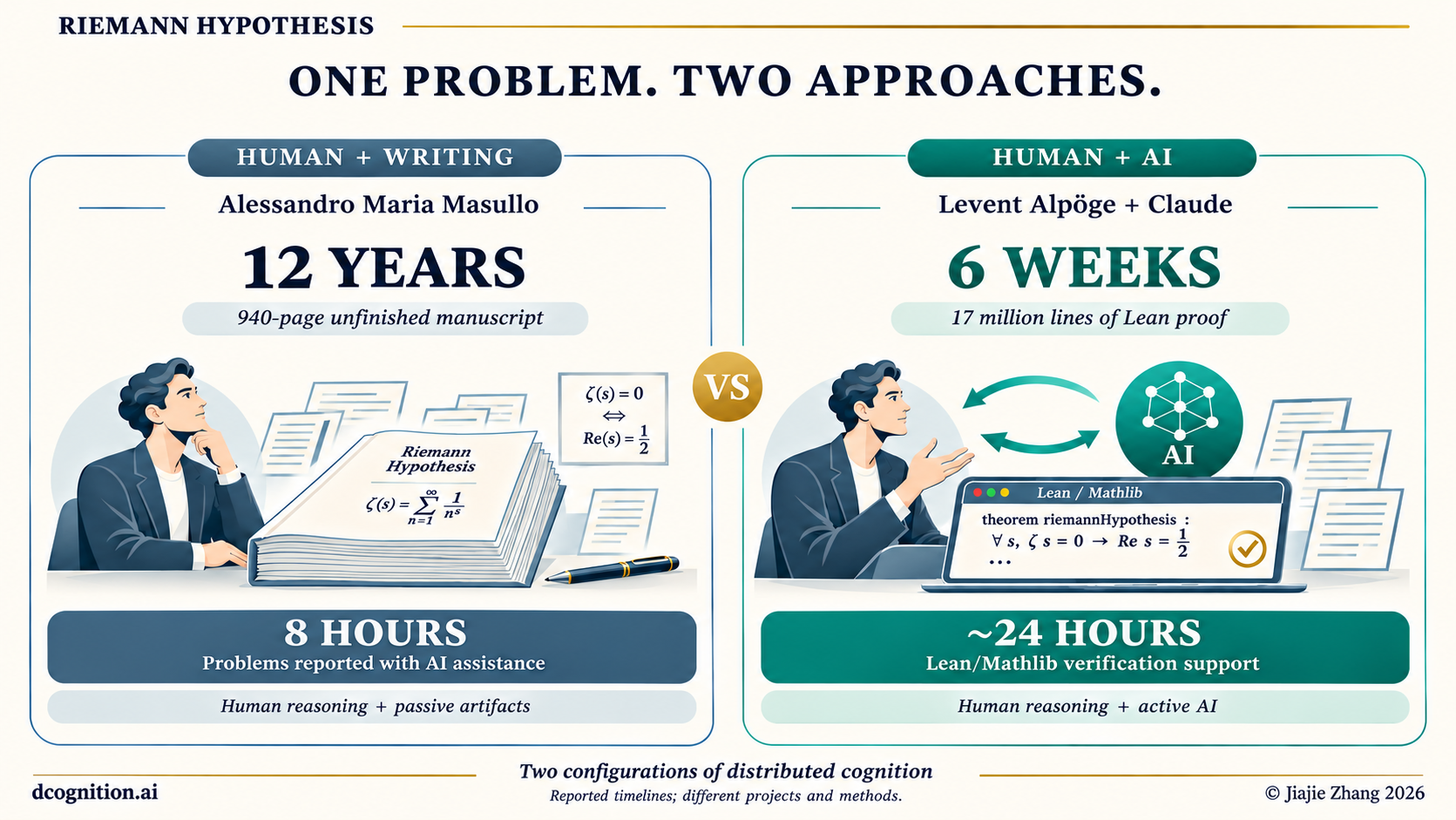
Two approaches to a historic problem
On November 20, 2026, Levent Alpöge announced a proof of the Riemann Hypothesis developed with Claude. His recorded development timeline spans approximately six weeks, culminating in roughly 17 million lines of formal mathematical code. Hours later, Ravi Vakil released a competing, unfinished manuscript by Alessandro Maria Masullo. (Nature coverage; Alpöge’s announcement.)
Masullo’s manuscript ran to 940 pages and reflected twelve years of work. Brian Conrad had been reviewing it for months, with further refinement planned. About eight hours after its release, Vakil reported that researchers using different AI models had identified problems. (Masullo background; Vakil’s announcement.)
By November 21, the Lean and Mathlib communities had expressed full confidence in Alpöge’s formal proof. On November 25, Nature reported broad acceptance of the claim. Work to explain and simplify the mathematics continues. (Verification statement; Nature update.)
The timelines are striking, but they compare different projects, methods, and scopes. Six weeks also rests on years of expertise and generations of accumulated mathematics. The consequential question is what the new organization of that expertise makes possible.
From speech to AI
Both approaches already involve distributed cognition. Mathematicians think with written arguments, notation, diagrams, reference works, and other people. The human-written approach relies primarily on artifacts that preserve and organize ideas; the intellectual contributions come from people.
From my historical perspective, this distinction belongs within a much longer transformation:
Speech enabled people to think together, exchange ideas, and coordinate action.
Writing gave thought durable external memory, making knowledge available beyond the original speaker.
Mathematics created symbolic structures for representing problems and carrying out reasoning that would otherwise be difficult or impossible.
The internet connected people and accumulated knowledge on a global scale.
AI introduces artifacts that can generate, criticize, and revise intellectual contributions within the cognitive system.
Passive does not mean unimportant. A notation can transform a problem, and a written argument can reveal a contradiction. But the inscription itself does not propose a new conjecture or revise the proof.
AI makes the artifact an active participant in the cognitive process.
Computers had already automated calculations and search. AI extends that history into the production and evaluation of ideas across a widening range of intellectual tasks.
Humans and AI can both propose, critique, and revise. The division of cognitive labor can change as the problem changes.
Polymath expands the cognitive system
The verification process is essential to this story. The Lean and Mathlib statement describes checks that the proof establishes the intended theorem, that its code compiles, and that independent proof checkers accept the exported argument. Confidence comes from a structured process of scrutiny. (Verification statement.)
Then the collaboration opened to the world.
On November 24, Anurag Sahai, Will Sawin, and Lior Silberman announced the G.R.H. Polymath initiative in a guest post on Terence Tao’s blog. They proposed coordinating worldwide efforts to develop an understandable account of the proof, clarify the surrounding literature, explore its mathematical advances, and pursue further generalizations. A public discussion forum would let participants share progress and reduce duplicated effort.
For me, Polymath illustrates how the cognitive system can keep expanding. The collaboration among a mathematician, Claude, and formal verification becomes the foundation for a broader network of researchers examining different parts of the argument, sharing explanations, challenging interpretations, and developing new results.
Distributed cognition now extends across the life of a discovery: producing an argument, checking it, explaining its structure, and opening new lines of inquiry.
The system reorganizes as the intellectual task changes. A breakthrough creates new work, new connections, and new possibilities for discovery.
What the Cognitive Revolution demands
This is the transformation I explore in The Cognitive Revolution: intelligence increasingly operates through systems whose capabilities depend on how people, technologies, and representations are organized.
An AI subscription gives an organization access to a model. A functioning cognitive system requires shared knowledge, clear ways to exchange work, independent checks, and processes that expose and correct mistakes.
Research leadership must therefore include the design of these systems: choosing consequential questions, coordinating different capabilities, and establishing what evidence justifies confidence. Credit and resources should also reach the people who build shared libraries, verification methods, and the infrastructure that makes collaboration possible.
A research organization that generates ideas faster than it can test them has simply moved its bottleneck. Verification and coordination need to advance alongside generation.
The defining advantage in the Cognitive Age will be the power of the cognitive systems we design.
Continue Reading and Watching
Original essay: 12 Years vs 6 Weeks in Mathematical Discovery
Book: The Cognitive Revolution: How AI Is Reorganizing Intelligence, Expertise, and Institutions
Accompanying video: The Cognitive Revolution
Website: dcognition.ai
Subscribe for more essays on AI, distributed intelligence, science, and institutional change.
How I Use AI
The ideas, arguments, and conceptual framework originate in my research and my book. For this essay, I used AI as a cognitive partner to expand the argument, research sources, develop drafts, and refine the writing. I retain responsibility for the intellectual direction, conclusions, and final text. This collaboration reflects a central theme of my work: thinking increasingly takes place through distributed systems.
© 2026 Jiajie Zhang. All rights reserved.
Brief quotations with attribution and a link to the original publication are welcome. No part of this article may be reproduced, republished, or distributed in whole or in substantial part without prior written permission from the author.
No approved comments yet. You can begin the discussion.